
Northern Thailand is one of my favourite regions to explore, with its beautiful temples, green countryside, traditional villages and fascinating local culture. During my stay in Chiang Mai, I decided to take a Chiang Rai day trip from Chiang Mai, visiting some of the region’s most famous attractions and the Golden Triangle, where Thailand, Laos and Myanmar meet.
I booked a full-day guided tour through GetYourGuide, which included the spectacular White Temple, Blue Temple, Black House Museum, a Long Neck Karen Village, natural hot springs and a boat trip along the Mekong River.
What made this experience particularly interesting was the variety. In just one day, I went from learning about traditional village life to exploring extraordinary temples, discovering unusual artwork and travelling by boat between the borders of three countries.
The tour cost me ฿2,375 per person, with a buffet lunch, drinks and fruit included. My guide collected me from my accommodation in Chiang Mai at around 7:15 AM, and the entire experience lasted approximately 12–13 hours.
In this guide, I’ll share exactly what I experienced, what I enjoyed most, how the tour was organised and whether I think this day trip is worth taking.
Chiang Rai Day Trip: Quick Travel Guide
| Detail | My experience |
|---|---|
| Starting point | Chiang Mai, Thailand |
| Destination | Chiang Rai and the Golden Triangle |
| Tour type | Full-day guided group tour |
| Booking platform | GetYourGuide |
| Pickup time | Around 7:15 AM |
| Total duration | Approximately 12–13 hours |
| Price I paid | ฿2,375 for one adult |
| Food | Buffet lunch, drinks and fruit included |
| Main attractions | Karen Village, hot springs, White Temple, Blue Temple, Black House and Golden Triangle |
| Highlight | Mekong River boat ride and the temples |
These details reflect my own booking and experience. Tour prices, routes and inclusions can change.
How I Booked My Chiang Rai Tour from Chiang Mai
While staying in Chiang Mai, I wanted to explore more of northern Thailand without having to arrange several different journeys myself.
Chiang Rai has some incredible attractions, but many are spread across different locations. I decided that booking an organised day tour would be the easiest way to visit them in a limited amount of time.
I found a tour called “From Chiang Mai: Chiang Rai Temples and Golden Triangle Tour” on GetYourGuide.
My booking cost ฿2,375 for one adult. The experience included a guided itinerary, transport between the attractions, a buffet lunch, drinks and fruit.
I particularly liked the fact that I could visit so many different places in one day without worrying about organising transport or deciding which attraction to visit next.
If you are planning a similar trip, I recommend checking the full itinerary carefully before booking. Some Chiang Rai tours visit only the temples, while others include the Golden Triangle and additional cultural stops.
The Journey from Chiang Mai to Chiang Rai
My day began early when the tour guide arrived to collect me at around 7:15 AM.
After I boarded the minivan, we stopped at a few other hotels to pick up more travellers before leaving Chiang Mai.
Once everyone was on board, our guide explained the day’s itinerary, where we would stop and what we could expect throughout the journey.
I always appreciate this part of an organised tour because it helps you understand the schedule and gives you an opportunity to ask questions.
As we travelled north, I enjoyed watching the scenery through the window. We passed green countryside and rice fields, a completely different atmosphere from the busy streets and markets of Chiang Mai.
It was an early start, but I was excited to discover what this part of Thailand had to offer.
Visiting the Long Neck Karen Village
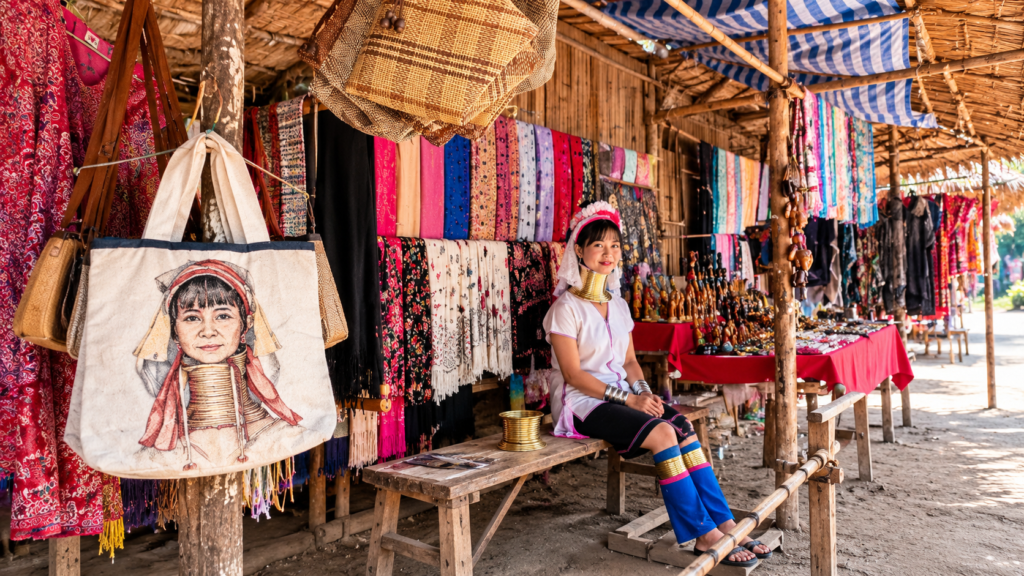
Our first major stop was a Long Neck Karen Village, one of the most memorable cultural experiences of my day.
The village is associated with the Kayan people, a community with roots in Myanmar, some of whose women traditionally wear brass coils around their necks.
These coils create the appearance of an unusually long neck, which is why the community is often described by tourists as the “Long Neck” village.
Learning About the Brass Neck Rings
One of the first things I noticed was the distinctive brass coils worn by some of the women.
Our guide explained aspects of the tradition and how the coils are introduced and added over time.
Interestingly, the coils do not actually stretch the neck itself. Their weight can change the position of the shoulders and upper chest, making the neck appear longer.
There are different cultural explanations for the tradition, and it is important not to reduce it to a single story. Today, these coils are also associated with cultural identity and heritage.
Traditional Weaving and Local Handicrafts
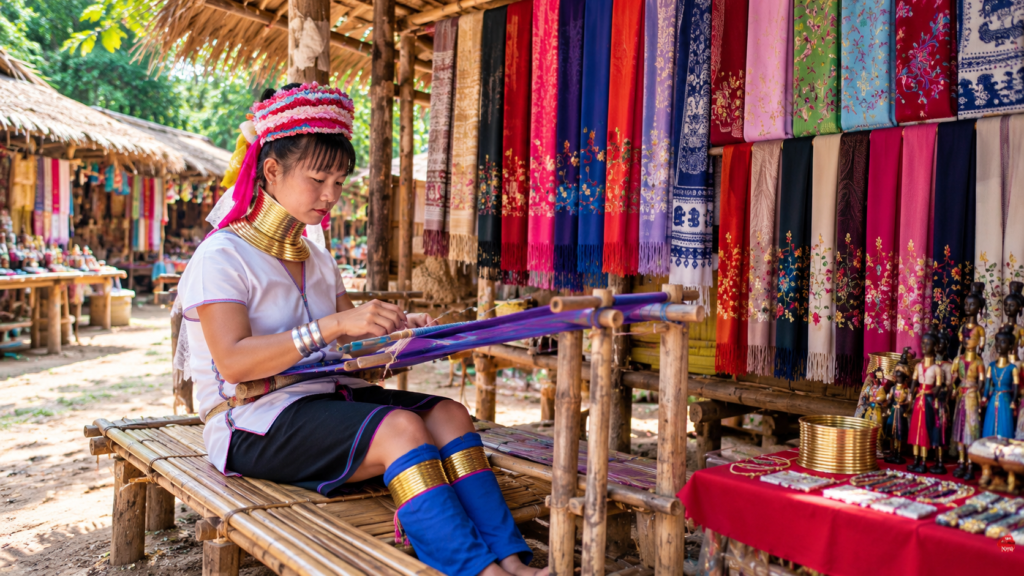
Another interesting part of the visit was watching women working on traditional weaving.
Several were creating colourful fabrics using relatively simple weaving equipment, and there were handmade textiles and souvenirs available to purchase.
I enjoyed seeing the craftsmanship involved and learning a little about how these products are made.
Before leaving, I bought a small souvenir figure to remember my visit.
The village itself had a peaceful atmosphere, surrounded by greenery.
However, I think it is important to approach this kind of cultural visit respectfully. The people living there are not simply tourist attractions. They have their own lives, traditions and personal stories.
If you visit, be considerate when taking photographs, ask permission where appropriate and consider supporting local craftspeople directly.
Mae Kachan Hot Springs: A Short Stop Along the Way
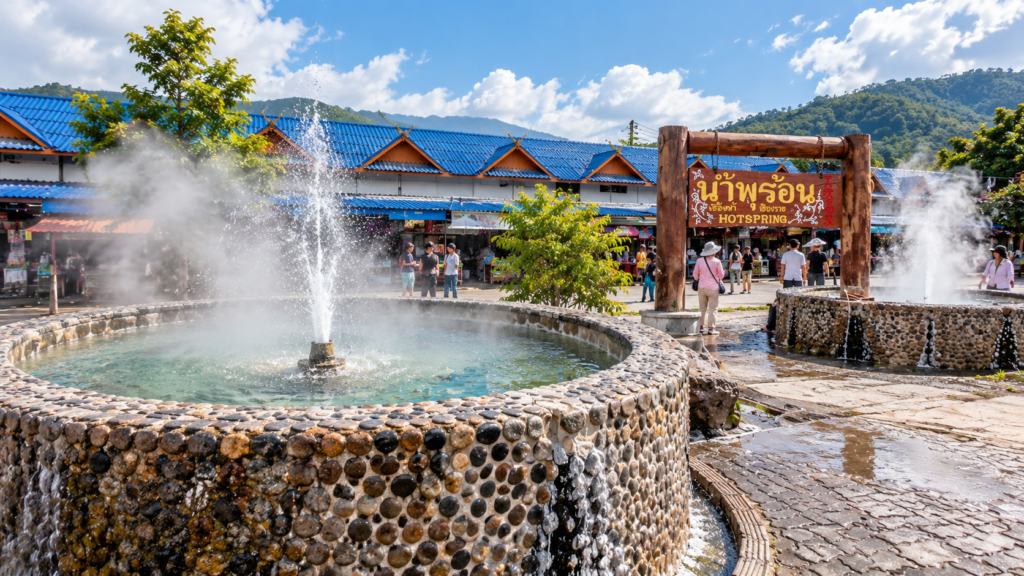
After leaving the village, we continued our journey and reached a hot spring stop approximately 25 minutes later.
Northern Thailand has several natural hot spring areas, and this was an interesting opportunity to see one during our journey.
As soon as I approached the springs, I could feel the warm steam rising into the air.
There was also a noticeable sulphur smell, which is common around some geothermal springs.
We had approximately 20 minutes to explore the area, walk around the small market and take photographs.
Although it was only a short stop, I enjoyed seeing something different before continuing towards Chiang Rai’s famous temples.
Afterwards, we travelled for roughly another hour and twenty minutes before reaching the White Temple.
White Temple (Wat Rong Khun): The Highlight of Chiang Rai
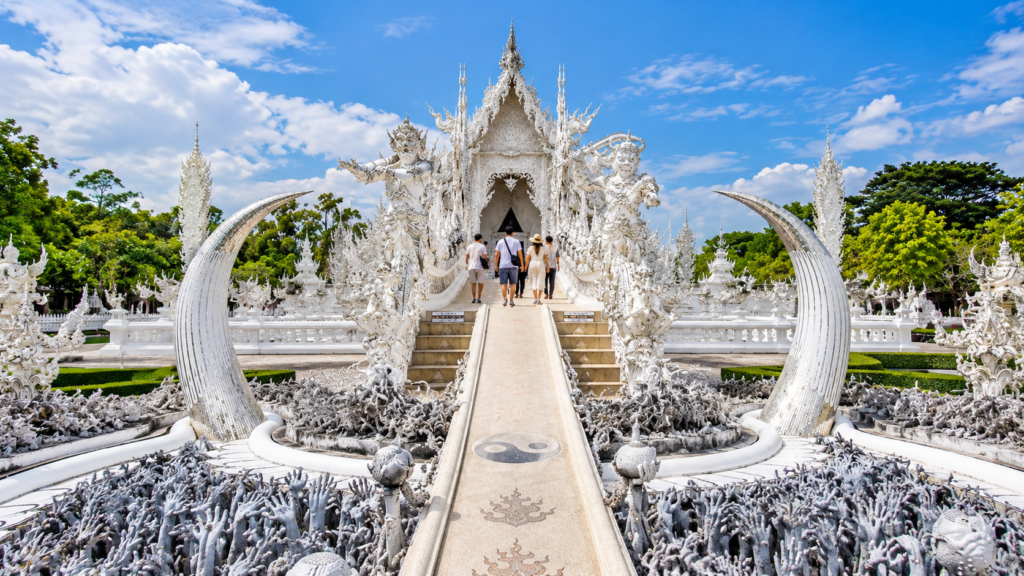
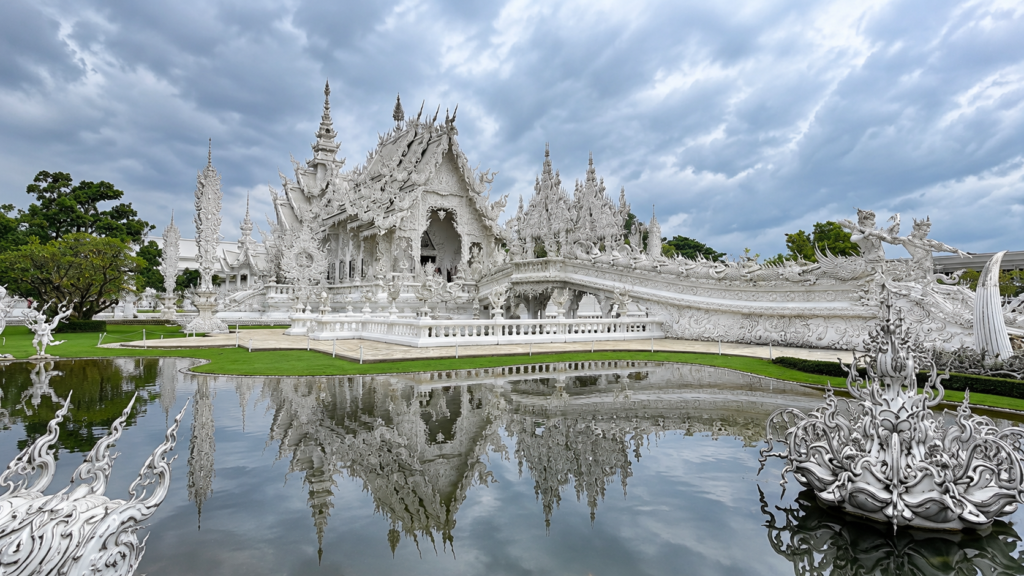
The White Temple, officially known as Wat Rong Khun, was one of the places I was most excited to visit.
And when I finally saw it in person, I understood why it is one of the most photographed attractions in northern Thailand.
Unlike the traditional golden temples you often see around Thailand, this temple is almost entirely white, with intricate sculptures, decorative details and reflective surfaces.
It looks more like something from a fantasy film than an ordinary temple.
What Makes the White Temple Special?
The White Temple is a contemporary artistic creation associated with Thai artist Chalermchai Kositpipat.
Its white colour is commonly interpreted as representing purity, while the reflective elements are associated with wisdom.
One of the most striking features is the entrance area, where sculpted hands reach upwards from below the walkway.
The imagery is dramatic and symbolic, creating a very different experience from visiting a conventional Buddhist temple.
As I walked towards the main building, I kept stopping to admire the details.
Everywhere I looked, there was something interesting to photograph.
My Experience Exploring the White Temple
Our guide mentioned that we were visiting during the rainy season, when the temple was relatively quiet compared with busier periods.
That made it easier to explore and take photographs without enormous crowds in the background.
I spent around an hour walking through the complex, filming and photographing the architecture.
In fact, I became so absorbed in exploring that I lost track of time.
Eventually, I received a call because the rest of the group was waiting for me!
That probably tells you how much I enjoyed the place.
If you are interested in photography or unusual architecture, I would definitely recommend visiting the White Temple.
My tip: Allow enough time to explore the surrounding buildings as well as the main temple. There is more to see than just the famous white façade.
Our temple admission was arranged as part of the tour.
Buffet Lunch at a Local Restaurant
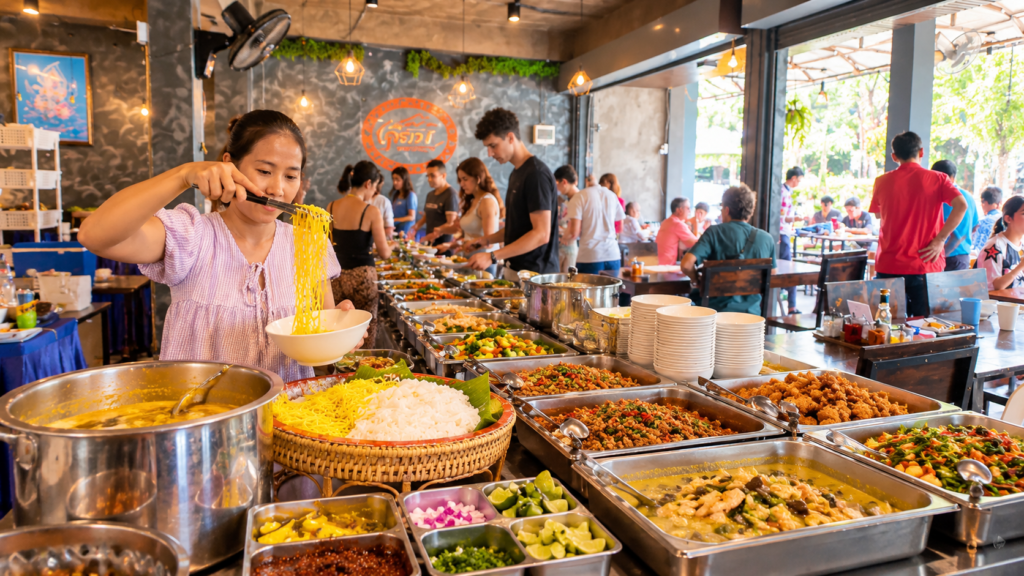
After visiting the White Temple, it was time for lunch.
We stopped at a busy local restaurant that catered to tour groups, and lunch was included in my booking.
It was a buffet-style meal, which meant we had several dishes to choose from.
I particularly appreciated having a choice rather than being given one fixed meal.
During lunch, I decided to try khao soi, a northern Thai noodle dish that I had already enjoyed during my time in Chiang Mai.
The version I tried was served with chicken, and I added fresh herbs, spring onions, coriander and lime.
I enjoyed the food, and it was a welcome break after our early start and morning sightseeing.
Drinks and fruit were also provided during the tour.
For anyone booking a full-day excursion, having lunch included is a useful advantage because it makes the day easier to organise.
If you have dietary requirements, I recommend checking the available options with the tour operator before booking.
Blue Temple (Wat Rong Suea Ten): A Beautiful Contrast
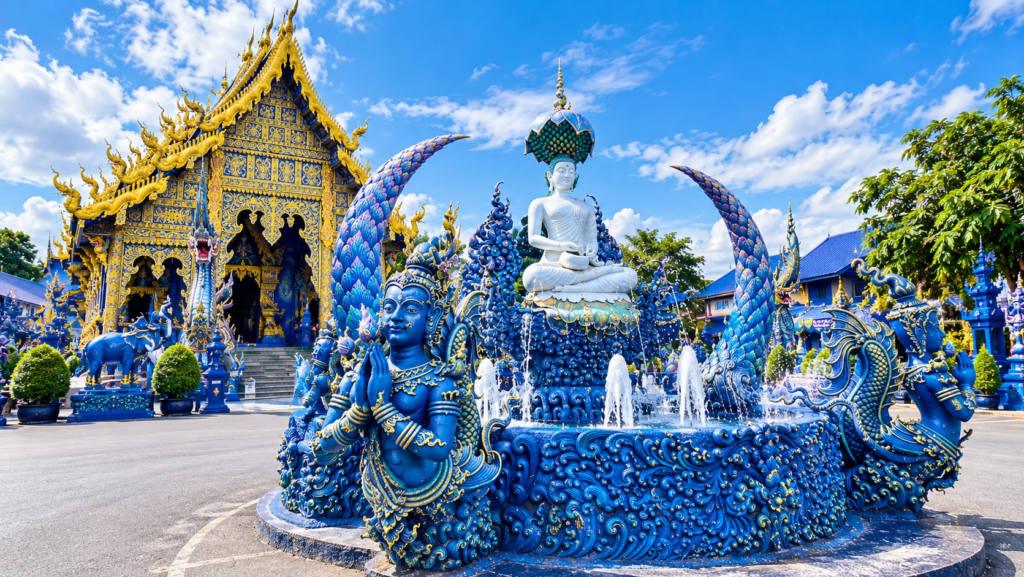
Our next stop was the Blue Temple, officially called Wat Rong Suea Ten.
After visiting the almost completely white Wat Rong Khun, arriving at a temple dominated by deep blue and gold colours was a fascinating contrast.
The first thing that caught my attention was the intense blue colour used throughout the architecture.
The exterior features elaborate sculptures, decorative patterns and golden details.
Inside, the temple has an equally impressive atmosphere, with beautiful Buddhist artwork and a large white Buddha statue.
My Experience at the Blue Temple
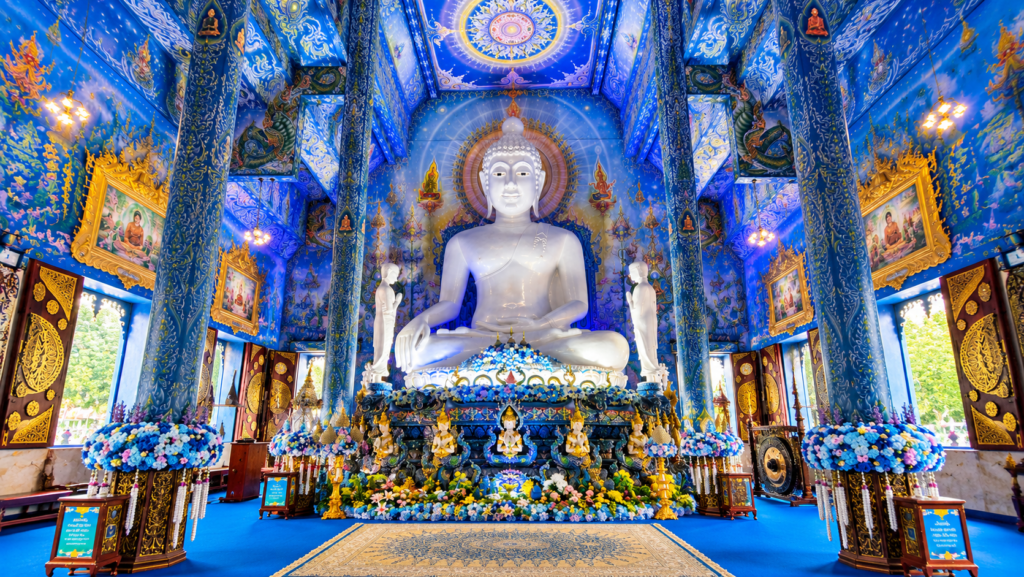
I found the Blue Temple visually striking, especially because it felt so different from the White Temple we had visited earlier.
While the White Temple has a dramatic, almost surreal appearance, the Blue Temple feels colourful, decorative and more recognisably connected to traditional Buddhist temple design.
The combination of blue, gold and white creates excellent opportunities for photography.
I spent time admiring the decorations and filming the different details around the temple.
If you are planning to visit Chiang Rai independently, I would recommend seeing both temples rather than choosing only one.
They offer very different experiences, and each has its own character.
Travel tip: Remember that the Blue Temple is an active religious site. Dress respectfully and follow any rules about footwear, photography and behaviour inside the buildings.
Black House Museum (Baan Dam): Chiang Rai’s Most Unusual Attraction
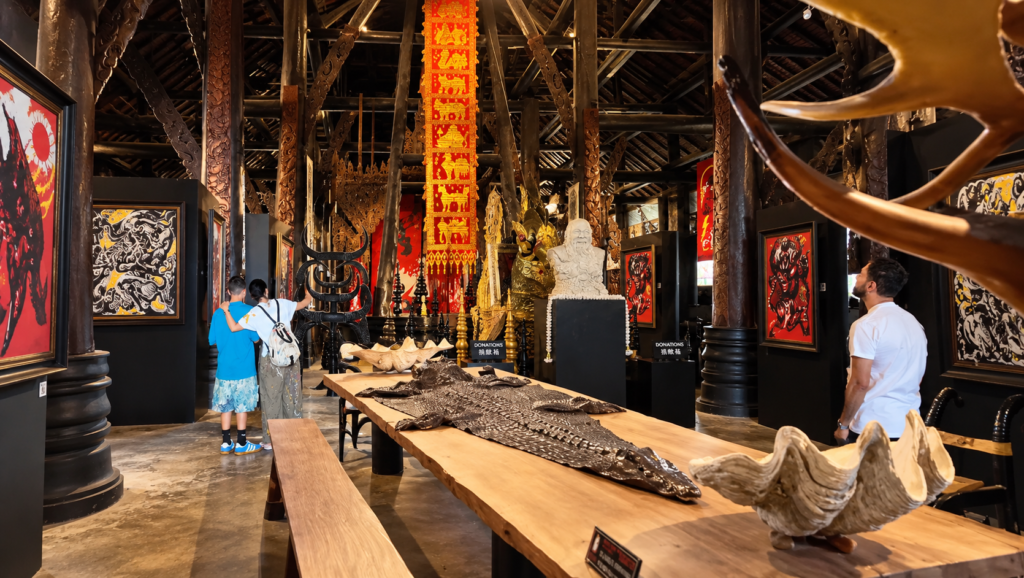
After the colourful temples, we visited somewhere completely different: the Black House Museum, also known as Baan Dam Museum.
This was one of the strangest and most mysterious places I explored during my trip.
The museum is associated with the late Thai artist Thawan Duchanee, whose work combines art, architecture, symbolism and elements of nature.
The complex contains dark wooden buildings filled with unusual objects and artistic displays.
Exploring the Black House
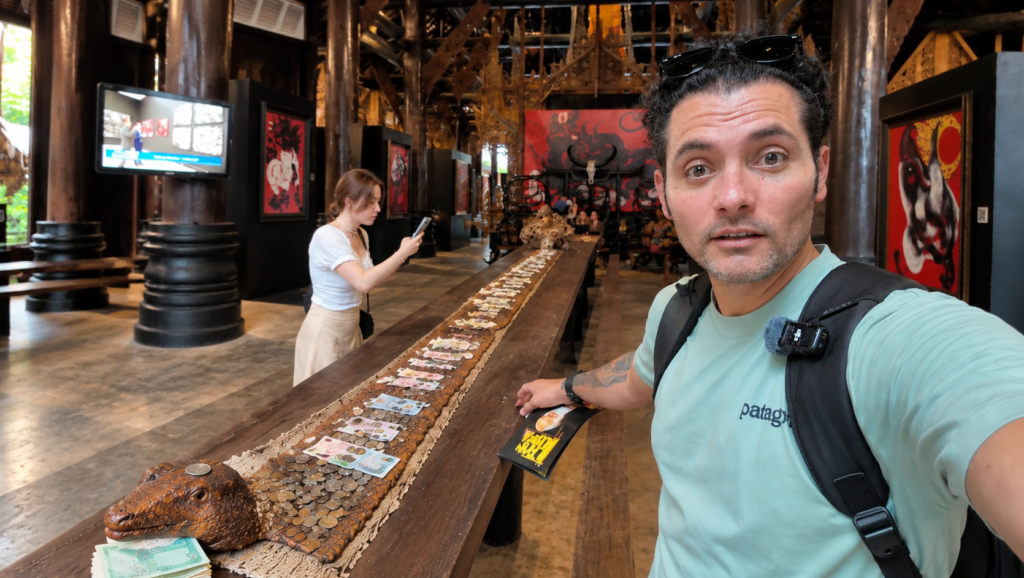
As I walked around, I noticed large wooden structures, animal horns, skulls, skins and unusual sculptures.
The atmosphere was completely different from the temples we had visited earlier.
The dark buildings, surrounding trees and strange collections created an almost mysterious feeling.
Some of the exhibits were fascinating, while others were quite unsettling.
I remember seeing large animal skins and horns and wondering about the stories behind the objects.
The museum explores themes that can include life, death, nature and the darker aspects of human experience.
Is the Black House Worth Visiting?
I think the Black House is particularly interesting if you enjoy art, architecture or unusual attractions.
It is not a traditional temple, despite sometimes being described as the Black Temple.
It is an artistic complex, and the experience is very different from visiting the White or Blue Temple.
Personally, I enjoyed the contrast.
In one day, I had experienced three places with completely different visual styles: a white artistic temple, a vivid blue Buddhist temple and a dark, unconventional museum.
That variety was one of the reasons I enjoyed this tour so much.
Golden Triangle: Where Thailand, Laos and Myanmar Meet
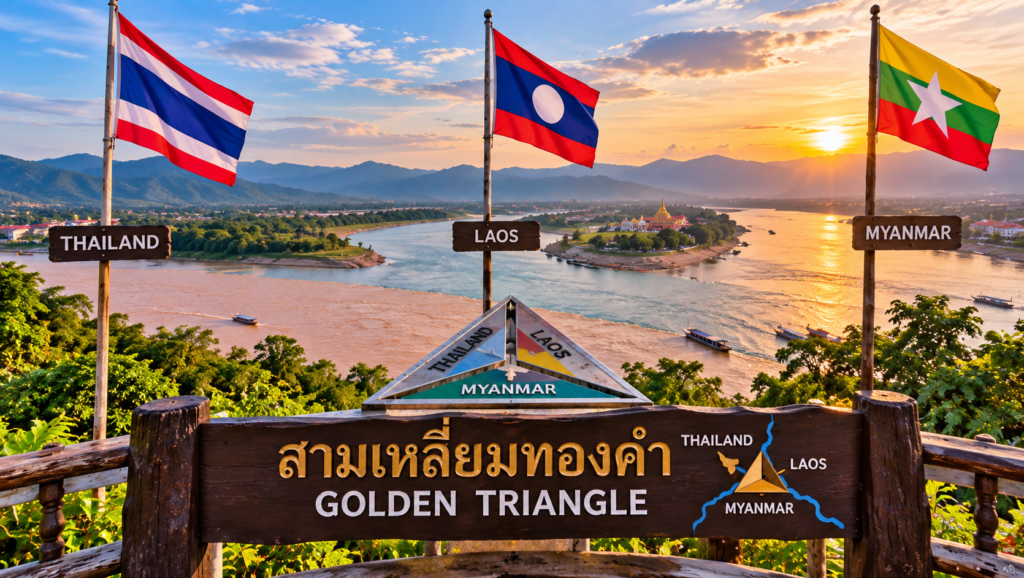
The final major destination of our tour was the famous Golden Triangle.
This is the area where Thailand, Laos and Myanmar meet, near the confluence of the Mekong and Ruak rivers.
I had heard about the Golden Triangle before visiting northern Thailand, but seeing the area in person was a completely different experience.
Standing there and looking across the rivers towards neighbouring countries was fascinating.
The History of the Golden Triangle
The Golden Triangle is historically associated with the cultivation and trade of opium.
For many years, parts of this wider border region were important centres of opium production and trafficking.
Over time, Thailand introduced development and crop-substitution programmes in parts of its northern highlands, encouraging alternatives such as coffee, tea and other agricultural products.
Today, the Golden Triangle is also a popular tourism destination, attracting visitors interested in its geography, history and cross-border setting.
For me, the most exciting part was not simply learning about the history but experiencing the area from the water.
My Mekong River Boat Ride
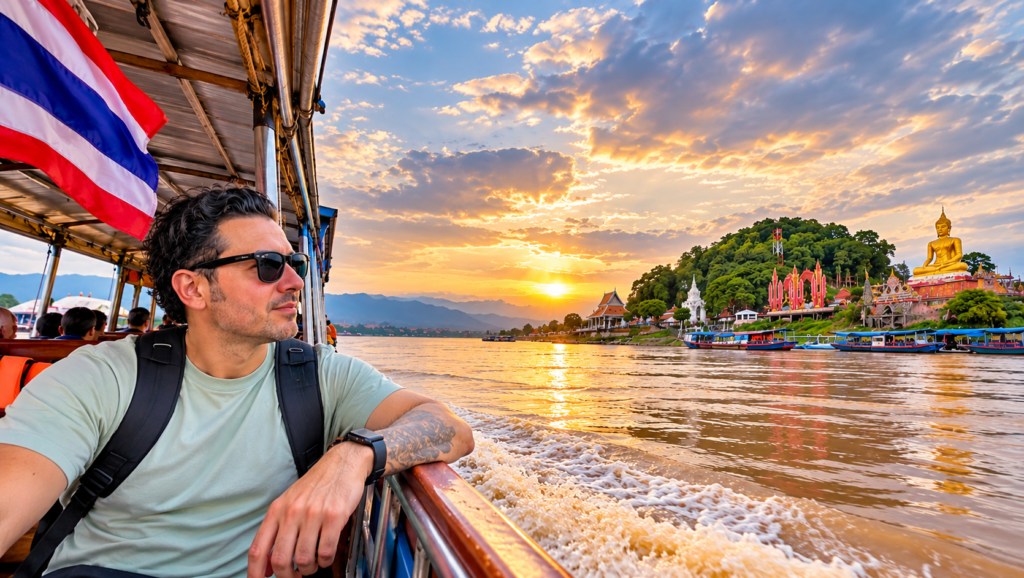
One of my favourite moments of the entire day was taking a boat ride on the Mekong River.
We boarded a boat near the Golden Triangle and travelled along the river, with Thailand, Laos and Myanmar nearby.
It was fascinating to see how close these countries are geographically.
From the boat, we could see buildings, riverbanks and developments on the different sides of the border.
Our guide pointed out areas across the river, including developments in Laos.
I also noticed buildings and hotels on the Lao side, and our guide discussed the investment and tourism developments taking place there.
What Was the Boat Ride Like?
The boat ride was a really enjoyable way to finish the day.
After spending hours travelling by road and walking around temples and museums, being on the river felt completely different.
There was music playing during part of the journey, which added to the atmosphere.
I enjoyed looking across the water, taking photographs and appreciating the unusual experience of being so close to three different countries.
It was one of those travel moments that stays in your memory.
Important: A boat ride in the Golden Triangle does not automatically mean you have entered another country. Border crossings and landing arrangements depend on the specific excursion and immigration rules.
If you book a similar tour, check whether the boat ride is included in the advertised price and whether the boat makes any stops across the border.
How Much Did My Chiang Rai Day Trip Cost?
I paid ฿2,375 for one adult when I booked my tour through GetYourGuide.
For that price, I experienced a full day of sightseeing across northern Thailand, with organised transport between the different attractions.
My booking included a buffet lunch, drinks and fruit, and our guide provided information throughout the journey.
The tour also arranged admission to the White Temple.
I particularly appreciated not having to organise separate transport between the many stops.
However, tour prices and inclusions vary, so always check the current booking details before making a reservation.
Was It Good Value for Money?
For me, yes.
Considering how many places we visited in a single day, I felt that the tour offered good value.
If I had tried to arrange everything independently, I would have needed to plan a long driving route and work out transport between several attractions.
The organised tour allowed me to concentrate on exploring, filming and enjoying the experience.
Of course, independent travel gives you more flexibility, especially if you want to spend longer at individual attractions.
But for someone with limited time in Chiang Mai, a guided day trip can be a practical option.
Is a Chiang Rai Day Trip from Chiang Mai Worth It?
Based on my experience, I would definitely recommend considering this tour, particularly if it is your first visit to northern Thailand.
What I enjoyed most was the variety of attractions.
The White Temple was spectacular, the Blue Temple was beautiful, the Black House Museum was unusual, and the Golden Triangle boat ride was a memorable experience.
I also enjoyed visiting the Karen village and seeing a different side of local life.
However, there is one important thing to consider: it is a long day.
My tour started with a pickup around 7:15 AM and lasted approximately 12–13 hours.
There was a considerable amount of driving, and because we visited several places, our time at each attraction was limited.
At the White Temple, for example, I enjoyed exploring so much that I almost forgot about the schedule!
If you prefer slow travel, you might find it better to spend one or two nights in Chiang Rai and explore at your own pace.
But if you are staying in Chiang Mai and want to see several famous attractions in one day, I think an organised tour is a very convenient choice.
Practical Tips for Visiting Chiang Rai from Chiang Mai
1. Be Prepared for an Early Start
My pickup was around 7:15 AM, so I recommend getting a good night’s sleep beforehand.
A full-day tour with several stops can be tiring, especially after a long return journey.
2. Bring a Camera or Fully Charged Phone
There are plenty of opportunities for photography, particularly at the White Temple, Blue Temple and Golden Triangle.
I filmed my experience for my YouTube channel, and I was glad I had my camera with me.
3. Wear Comfortable Shoes
You will spend time walking around temple complexes, museums, village areas and viewpoints.
Comfortable footwear makes the day much easier.
4. Dress Respectfully at Temples
Some of the attractions are religious sites, so avoid overly revealing clothing and follow the local rules.
A lightweight layer can also be useful during the journey.
5. Carry Some Thai Baht
Even if your tour includes food and admission fees, you may want to purchase souvenirs, snacks or drinks.
I bought a small souvenir during my visit to the Karen village.
6. Check the Weather
Northern Thailand can experience heavy rain during the wet season.
The rainy season may also mean fewer visitors at some attractions, as I experienced at the White Temple.
However, weather conditions can change, so bring suitable clothing and check the forecast before travelling.
7. Check What Your Tour Includes
Not every Chiang Rai tour follows the same itinerary.
Some visit only the temples, while others include the Golden Triangle, cultural villages and boat excursions.
Check the pickup arrangements, lunch, admission fees, boat ride and expected return time before booking.
Can You Visit Chiang Rai Independently?
Yes, it is possible to visit Chiang Rai independently from Chiang Mai.
You can travel by bus, hire a private driver or rent a car if you are comfortable driving in Thailand.
However, the attractions included in my tour are spread across a fairly large area.
The Golden Triangle is farther north than Chiang Rai city, so including it alongside the temples makes the day significantly longer.
If you want to explore independently, I would recommend considering an overnight stay in Chiang Rai rather than trying to fit everything into one day.
This would give you more flexibility to explore the temples, local markets and surrounding countryside.
For travellers who have only one spare day in Chiang Mai, an organised excursion is often the simpler option.
Frequently Asked Questions About Chiang Rai Day Trips
How long does a Chiang Rai day trip from Chiang Mai take?
My tour lasted approximately 12–13 hours, including transport and sightseeing. The exact duration depends on the itinerary, traffic and pickup location.
Is Chiang Rai worth visiting from Chiang Mai?
Yes, especially if you enjoy temples, art, cultural experiences and beautiful scenery. The White Temple alone is a memorable attraction, but there is much more to explore.
How much does a Chiang Rai day tour cost?
I paid ฿2,375 for my guided tour. Prices vary depending on the operator, itinerary and included activities, so check current rates before booking.
Can you visit the White Temple and Blue Temple in one day?
Yes. Both are in the Chiang Rai area, and many organised tours include them in the same itinerary.
Is the Golden Triangle included in every Chiang Rai tour?
No. Some tours focus only on Chiang Rai’s temples. If you want to visit the Golden Triangle, make sure it is specifically listed in your booking.
Is the Chiang Rai day trip suitable for everyone?
The attractions are interesting for many different travellers, but the long journey and early start may be tiring for young children or anyone who prefers a slower pace.
Check accessibility and walking requirements with the tour operator if necessary.
Should I stay overnight in Chiang Rai?
If you have enough time, staying overnight can be a good idea. It allows you to explore the area at a more relaxed pace and spend longer at individual attractions.
Watch My Chiang Rai and Golden Triangle Travel Vlog
I filmed my journey from Chiang Mai to Chiang Rai, including the Karen village, hot springs, White Temple, Blue Temple, Black House Museum and Golden Triangle boat ride.
In the video, you can see what the attractions actually look like, follow my journey and experience the atmosphere of northern Thailand.
Final Thoughts: Would I Recommend This Chiang Rai Tour?
Looking back, this was one of the most varied and memorable day trips I experienced in northern Thailand.
I started the morning in Chiang Mai, visited a traditional village, explored natural hot springs, discovered some of Thailand’s most unusual temples and artworks, and finished the day with a boat ride on the Mekong River.
My favourite parts were the White Temple and the Golden Triangle boat ride, although every stop offered something different.
The tour was long, and I would have liked more time at certain attractions, particularly the White Temple. But considering how much we managed to see, I was very happy with the experience.
If you’re visiting Chiang Mai for the first time and want to explore beyond the city, I think a Chiang Rai day trip from Chiang Mai is well worth considering.
And if you have more time, staying overnight in Chiang Rai would allow you to discover the region at a slower pace.
Have you visited Chiang Rai or the Golden Triangle? I’d love to hear which attraction you enjoyed most, or which one you would like to see on your next trip to Thailand.