
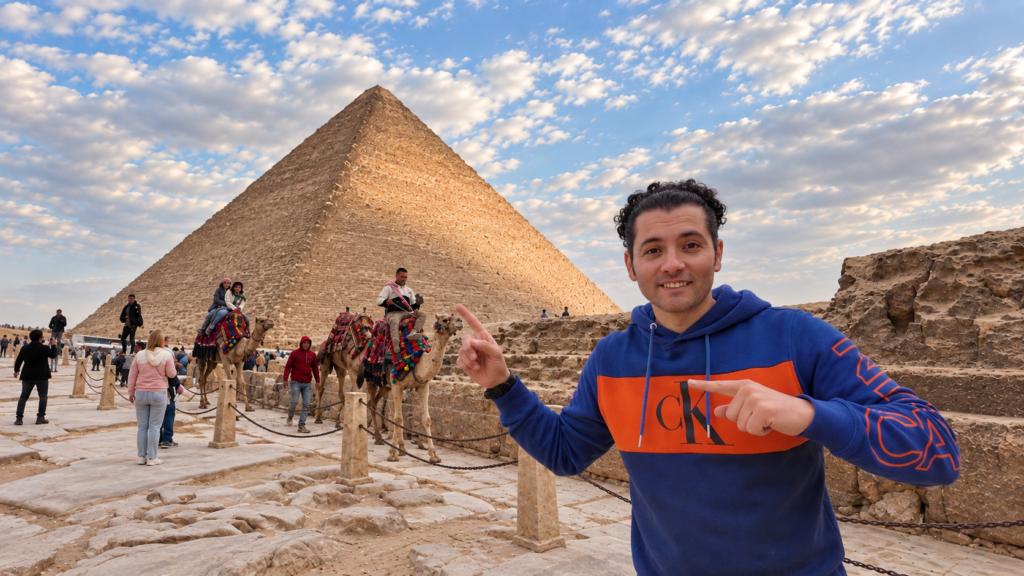
I had seen the Pyramids of Giza countless times in photographs, documentaries and films, but nothing compared to seeing them with my own eyes — and eventually going inside the Great Pyramid of Giza myself.
My day started in the heart of Cairo. I left Downtown Cairo and took a taxi towards Giza. I was excited because visiting the Pyramids of Giza was one of the experiences I had been looking forward to most during my time in Egypt.
As we got closer to Giza, I couldn’t stop thinking about what I was about to see. Somewhere ahead of me were monuments that had survived for more than 4,500 years.
Eventually, I got out of the taxi and walked the rest of the way towards the entrance.
And this was where the adventure really started.
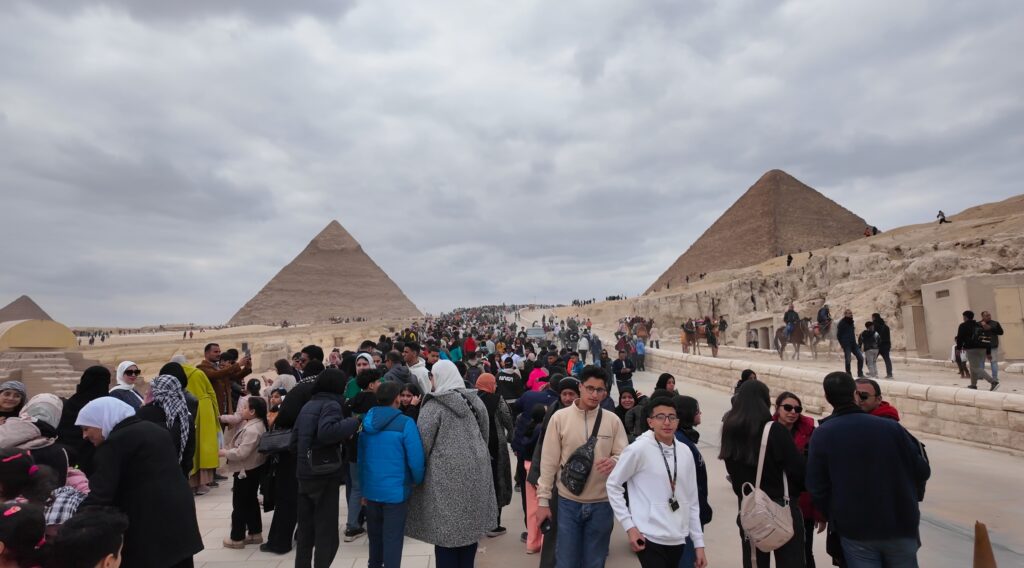
The entrance was incredibly busy. There were people everywhere, and buying a ticket was far more chaotic than I had expected. I immediately realised that I should have bought my ticket online before arriving.
Eventually, I managed to get my tickets and make my way inside.
But despite the crowds and confusion at the entrance, none of that really mattered once I started walking towards the pyramids.
Seeing the Great Pyramid of Giza getting closer and closer was surreal.
I had travelled to many incredible places before, but standing beneath a structure built thousands of years ago was different. At around 146 metres tall when originally completed, the Great Pyramid completely dominates the landscape when you stand close to it.
And I wasn’t only going to see it from the outside.
I had bought another ticket to go inside the Great Pyramid.
At that moment, I had no idea just how narrow, hot and physically demanding that experience was going to be.
Arriving at the Pyramids of Giza
After leaving Downtown Cairo, I took a taxi towards Giza. The taxi couldn’t take me all the way to the entrance, so I got out and continued on foot.
As I approached the entrance, I quickly realised just how busy it was. The ticket area was packed, with a huge number of visitors trying to get in. Looking at the crowd, I realised I had made a mistake — I should have bought my ticket online before coming.
The queue was so long that eventually I asked someone to help buy the tickets for me. I gave him the money for the tickets and also gave him a tip for helping me, which saved me from waiting in that huge queue.
There were different tickets depending on what you wanted to see. At the time of my visit, I paid EGP 700 for entrance to the Giza pyramid complex, while going inside the Great Pyramid required a separate EGP 1,000 ticket.
I hadn’t come all this way just to see the pyramids from the outside, so of course I wanted to experience the inside as well.
Once I finally had my tickets and passed the entrance, there were carts available to take visitors further into the site. But I decided to walk instead. The distance didn’t seem too far, and I wanted to experience the place properly on foot.
With the ticket chaos behind me, I could finally concentrate on why I had come here in the first place.
The Great Pyramid was right in front of me.
My First Impression of the Great Pyramid
The closer I got to the Great Pyramid, the more impressive it became. From a distance, you know it is huge, but standing close to it gives you a completely different sense of its scale.
I remember looking up at it and thinking about how long it had been standing there. The Great Pyramid was built more than 4,500 years ago for Pharaoh Khufu, yet here I was standing beneath it in modern-day Egypt.
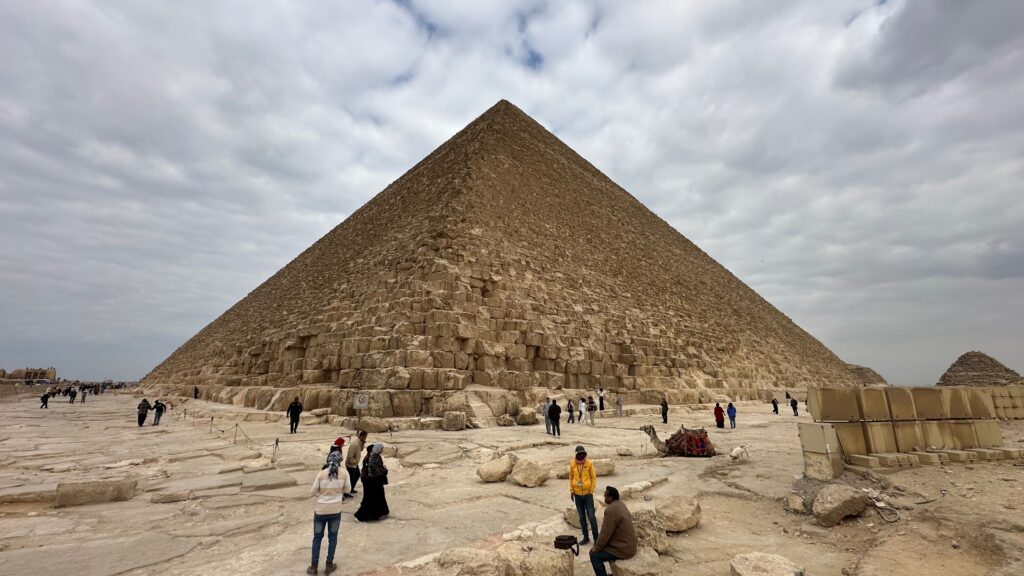
Originally, the Great Pyramid stood at around 146.5 metres tall. Today it is slightly shorter because its outer casing and uppermost sections have been lost over time. For thousands of years, it was the tallest human-made structure on Earth.
What fascinated me even more was seeing the individual stone blocks up close. When you see the pyramid in photographs, it almost looks like one smooth structure. Standing beside it, you realise just how enormous some of those blocks are — and it immediately makes you wonder how people managed to build something on this scale thousands of years ago.
The pyramid we see today also looks very different from how it would have appeared when it was completed. Much of the exterior was originally covered with smooth white limestone casing, creating a much cleaner and brighter surface than the exposed stone we see today.
And this wasn’t simply a giant monument. It was part of a much larger funerary complex connected to Khufu and ancient Egyptian beliefs about death, kingship and the afterlife.
Standing there, surrounded by all that history, I knew what I wanted to do next.
I wanted to go inside.
Going Inside the Great Pyramid of Giza
Walking towards the entrance of the Great Pyramid, I was excited, but I didn’t really know what to expect once I got inside.
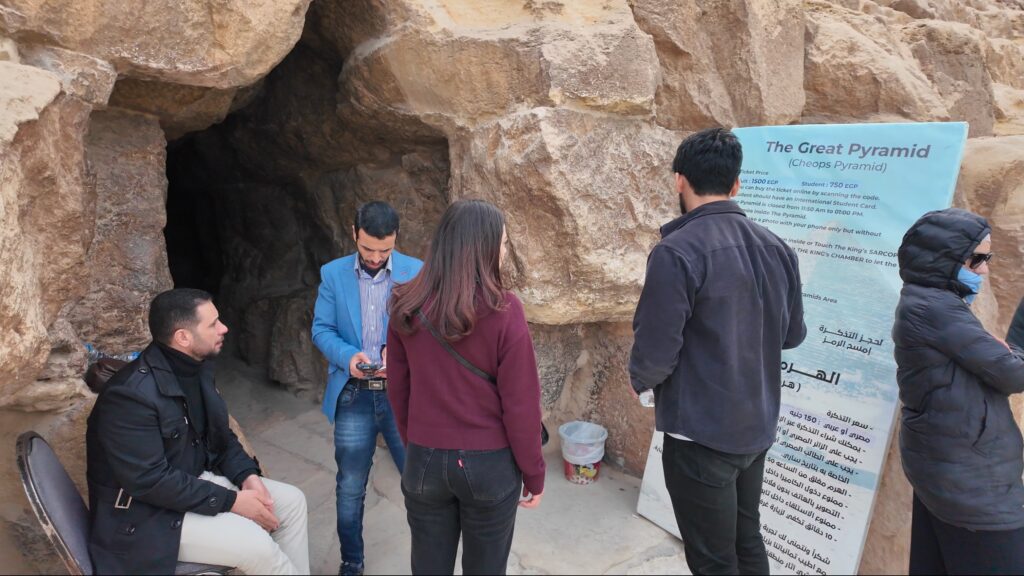
It didn’t take long to realise that this wasn’t going to be an easy walk through an ancient monument. The passage became extremely narrow, and in some parts I had to bend down and carefully make my way through while other visitors were moving in the opposite direction.
As we continued deeper inside, it became more difficult. Some people along the way seemed to regret going in and decided to turn around and head back out. I could understand why. It was hot, cramped and physically demanding, and there was still a long way to go.
At one point, the passage became so tight and crowded that we were almost stuck. There wasn’t enough room to move normally, and for a while we had to move forward in an almost seated, crouched position, slowly making our way through the confined space.
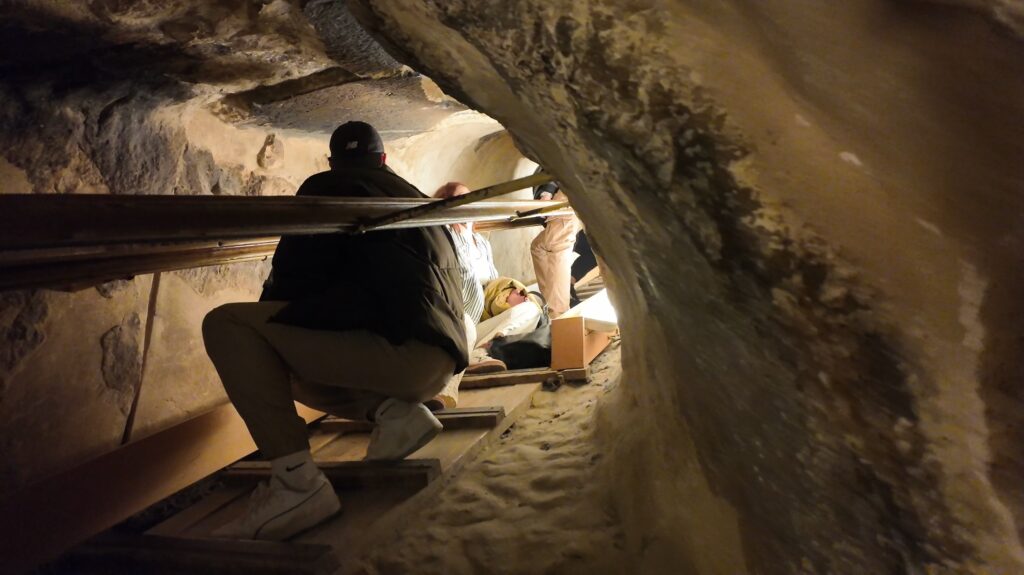
That was probably when I really understood how challenging going inside the Great Pyramid could be. This wasn’t simply walking into a historical building. I was climbing through an ancient passage with very little space around me, surrounded by enormous amounts of stone.
Eventually, the passage opened up and I was able to continue upwards towards the chamber.
Reaching the King’s Chamber
After all that climbing, heat and squeezing through the narrow passages, I finally reached the King’s Chamber.
I think many people imagine that the inside of an Egyptian pyramid will be filled with hieroglyphics, decorations, gold or ancient treasures. But the reality was very different.
The chamber itself was surprisingly simple. There were no colourful paintings or elaborate decorations on the walls. The main thing to see was the large stone sarcophagus associated with Pharaoh Khufu.
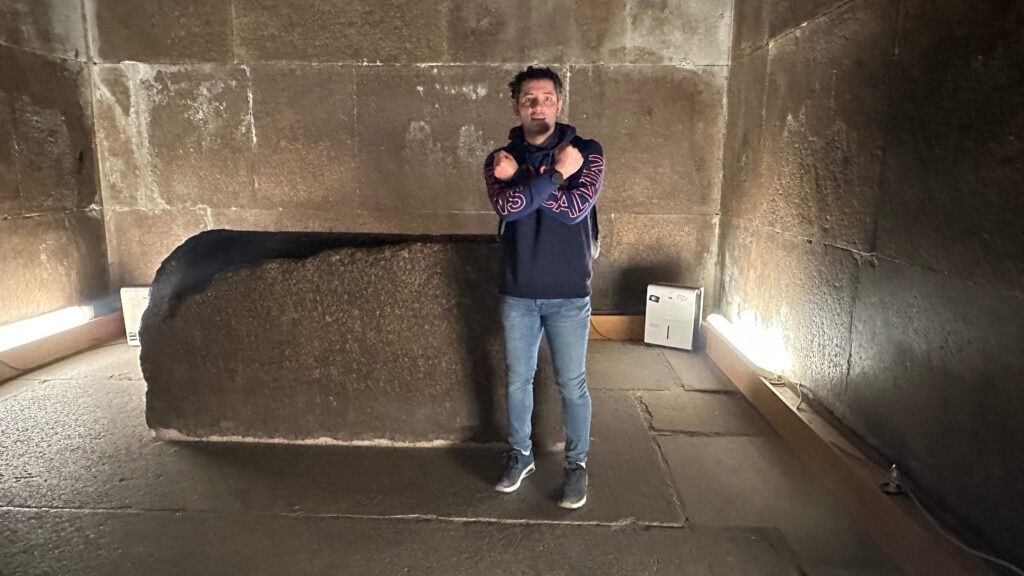
Standing there, though, was still an incredible feeling. I had just made my way deep inside a structure built more than 4,500 years ago, and now I was standing in the chamber at the end of that journey.
At the same time, I have to be honest: there isn’t actually very much to see inside the Great Pyramid.
For me, the most memorable part wasn’t what I found in the chamber. It was the experience of getting there — climbing through those narrow passages, feeling the heat, seeing some people turn back, and knowing that I was moving through the inside of one of the most extraordinary structures ever built.
Once I had seen the chamber and the sarcophagus, it was time to make my way back out.
But once I was back outside, I had one question: Was it actually worth it?
Is It Worth Going Inside the Great Pyramid?
When I came back outside, my feelings were a little mixed.
If you’re expecting to find beautifully decorated chambers, hieroglyphics or ancient treasures inside, you might be disappointed. The King’s Chamber itself is quite simple, and there isn’t a huge amount to see once you reach it.
In my video, I said honestly that going inside isn’t something everyone necessarily needs to do. The journey is hot, narrow and physically demanding, and after all that effort, you eventually reach a relatively simple chamber.
But for me, the experience was about more than what was waiting at the end.
I had actually been inside the Great Pyramid of Giza. I had climbed through its narrow passages, experienced how confined it feels, and stood inside a structure built more than 4,500 years ago.
So if you’re interested mainly in seeing beautiful interiors, you may not find what you’re expecting. But if the idea of experiencing the Great Pyramid from the inside fascinates you, then the journey itself is what makes it memorable.
Personally, I’m glad I did it. It’s one of those experiences I wanted to have at least once — although now that I know exactly what it’s like inside, I’m not sure I’d be rushing to do that climb a second time!
Want to see what it was actually like inside the Great Pyramid? Watch my full experience below.
Exploring the Rest of the Giza Pyramids
After coming back out of the Great Pyramid, I continued exploring the Giza Plateau. Khufu’s pyramid may be the largest and most famous, but it is only one part of this enormous ancient complex.
Not far away stands the Pyramid of Khafre, built for Khufu’s son. From certain angles, it can actually look taller than the Great Pyramid because it was constructed on slightly higher ground, although it is smaller.
One of the easiest ways to recognise Khafre’s pyramid is the section of smooth limestone casing that still survives near its top. It gives you a glimpse of how different these pyramids would have looked when much more of their exterior was covered in polished limestone.
The third main pyramid belongs to Menkaure. It is noticeably smaller than the other two, but together the three pyramids create the famous Giza skyline that I had seen so many times before coming to Egypt.
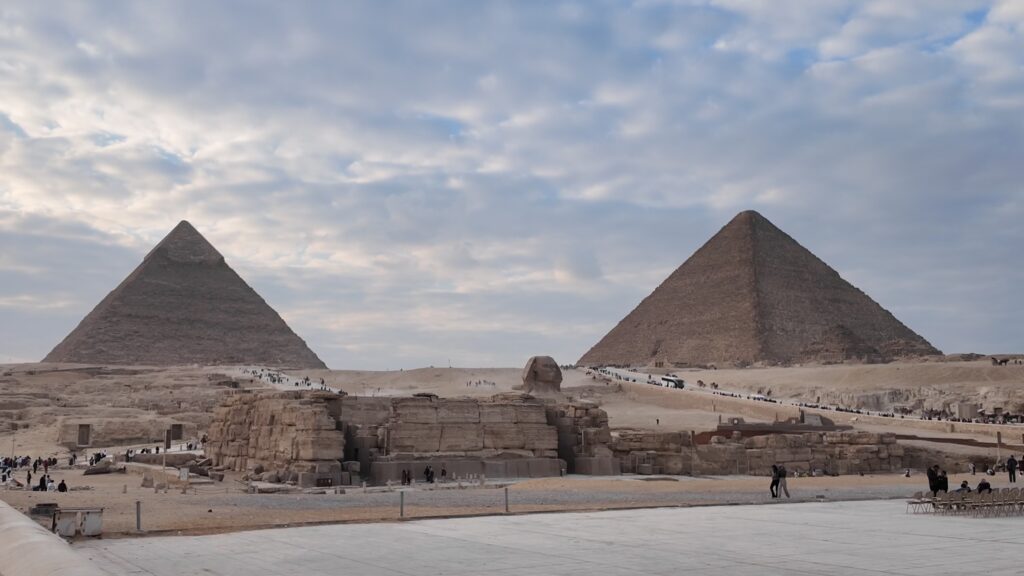
Walking around the site also made me think about why these enormous structures were built in the first place. For the ancient Egyptians, death wasn’t simply the end. Their beliefs about the afterlife were deeply connected to the pharaoh, burial rituals and the construction of these huge funerary complexes.
Seeing all three pyramids together helped me understand that Giza isn’t just about one famous monument. This was an entire landscape created for the dead more than four thousand years ago — and somehow, much of it is still standing today.
After spending more time around the pyramids, I continued towards another ancient monument that is almost as famous as the pyramids themselves:
the Great Sphinx of Giza.
Standing in Front of the Great Sphinx
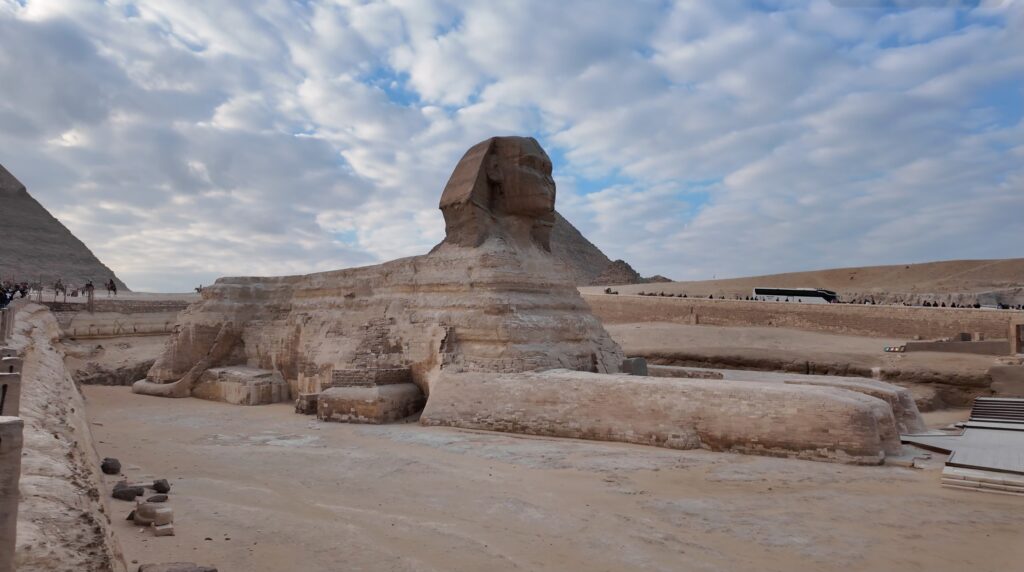
After exploring the pyramids, I made my way towards the Great Sphinx of Giza. Just like the pyramids, I had seen it countless times in photographs, but standing in front of it was a completely different experience.
Carved directly from the limestone bedrock, the Sphinx has the body of a lion and the head of a human. It is generally associated with Pharaoh Khafre, whose pyramid stands nearby, although questions about its exact history and purpose have been debated for many years.
What surprised me was how naturally the Sphinx fits into the landscape. With the pyramids rising behind it, you suddenly realise that you’re not looking at separate tourist attractions — they are all parts of an enormous ancient site that has survived for thousands of years.
The lion’s body is traditionally associated with strength and power, while the human head represents the king. Standing there, I tried to imagine what this entire area must have looked like when these monuments were new, rather than the ancient ruins we see today.
For me, seeing the Sphinx was the perfect way to finish my time at the Giza Plateau. I had started the day wanting to see the pyramids with my own eyes, but I ended up doing much more than that — I had walked beneath them, climbed inside the Great Pyramid and stood in front of one of the most recognisable monuments of ancient Egypt.
How Were the Pyramids Built?
Standing beside the pyramids, one question is almost impossible to avoid: how did people build something this enormous more than 4,500 years ago?
The Great Pyramid was constructed from millions of stone blocks. Much of the limestone came from the Giza Plateau itself, while finer white limestone used for the outer casing was transported from Tura, on the opposite side of the Nile. Granite used in important interior spaces came from much farther south, around Aswan.
For a long time, popular stories portrayed the pyramids as being built by slaves. Archaeological discoveries at Giza, however, have revealed settlements and tombs associated with organised groups of workers who helped construct the pyramid complex. The evidence points to a huge, highly organised workforce that included skilled labourers and supporting workers.
We still don’t know every detail of exactly how the Great Pyramid was constructed. Different ramp systems and building methods have been proposed, and archaeologists continue to study the evidence. What is clear is that the ancient Egyptians were capable of organising enormous amounts of labour, stone, food, transportation and engineering with remarkable precision.
When you stand close to the Great Pyramid and look at the size of the individual blocks, those numbers become much harder to comprehend. It is one thing to read about how old the pyramid is; it is another to stand underneath it and try to imagine people building it thousands of years before modern cranes, trucks or machinery existed.
For me, that mystery is part of what makes Giza so fascinating. Even after thousands of years of study, the pyramids still leave you with questions.
Visiting the Pyramids of Giza: Tickets & Practical Information
If you’re planning to visit the Pyramids of Giza, it’s worth knowing that the general entrance ticket and the ticket to enter the Great Pyramid are separate.
At the time of writing, the entrance price for foreign visitors to the Giza Plateau is EGP 700 for adults and EGP 350 for students. If you want to go inside the Great Pyramid of Khufu, you need a separate ticket, currently EGP 1,000 for adults and EGP 500 for students.
When I visited, the ticket area was extremely crowded. I ended up paying someone an extra EGP 500 to go and buy the ticket for me because getting through the crowd was so difficult. This wasn’t an official ticket fee — it was simply what I chose to pay for the help.
I recommend buying your ticket online before visiting if possible. After dealing with the crowds myself, I immediately wished I had bought mine in advance.
Opening hours and ticket prices can change, so check the latest information on the official Egyptian Ministry of Tourism and Antiquities website before your visit.
👉 Official Giza Plateau visitor information
My Final Thoughts on Visiting the Pyramids of Giza
Visiting the Pyramids of Giza was one of those travel experiences that felt completely different once I was actually there.
I had seen these monuments so many times before, but photographs never really showed me their true scale. Standing beneath the Great Pyramid, looking up at those enormous blocks of stone and knowing that they had been there for more than 4,500 years was something I won’t forget.
Going inside made the experience even more memorable. It wasn’t comfortable — it was hot, narrow and physically demanding, and there wasn’t much to see when I finally reached the chamber. But the feeling of knowing I had actually climbed through the passages inside the Great Pyramid made it worthwhile for me.
The day also reminded me that Giza is much more than just the Great Pyramid. Seeing the other pyramids, learning more about the people who built them and eventually standing in front of the Great Sphinx gave me a much better understanding of just how extraordinary this entire site is.
If I remember one thing most clearly, though, it is that first feeling of standing in front of the pyramids and realising:
I’m actually here.
After seeing them in pictures for so many years, the Pyramids of Giza were no longer something I had only read about or watched on a screen. They had become part of my own travel story.
Planning your own trip to Egypt? Check out my complete Egypt Travel Guide for more tips on costs, getting around, where to stay and planning your trip.